Wednesday, February 10, 2016

Monday, January 25, 2016

Thursday, November 5, 2015
Astronomy
In astronomy, a lunar distance (LD) is a measurement of the distance from the Earth to the Moon. The average distance from the center of the Earth to the center of the Moon is 384,400 km (238,900 mi).One astronomical unit is about 389 LD. The actual distance varies over the course of the orbit of the moon, from 363,104 km (225,622 mi) at the perigee and 405,696 km (252,088 mi) at apogee, resulting in a differential range of 42,592 km (26,465 mi).
Millimeter-precision measurements of the lunar distance are made by measuring the time taken for light to travel between LIDAR stations on the Earth and retroreflectors placed on the Moon. Lunar laser ranging measurement data is available from the Paris Observatory Lunar Analysis Center,[2] and the active stations.
The Moon is spiraling away from the Earth at an average rate of 3.8 cm (1.5 in) per year, as detected by the Lunar Laser Ranging Experiment.The recession rate is considered anomalously high.By coincidence, the diameter of corner cubes in retroreflectors on the Moon is also 3.8 cm (1.5 in).
The tidal dissipation rate has varied during the Earth's geological history.
The first person to measure the distance to the Moon was the 2nd-century-BC astronomer and geographer Hipparchus, who exploited the lunar parallax using simple trigonometry, measuring the distance as 400,000 kilometers. He was approximately 26,000 km (16,000 mi) off the actual distance, an error of about 6.8%.
All nine manned missions to the Moon took place as part of the Apollo program over a period of just under four years, from 21 December 1968 to 19 December 1972. Of the 24 people who have flown to the Moon, 17 are still living as of November 2015.
John Young, Eugene Cernan and Jim Lovell are the only three people to have flown to the Moon twice. Young and Cernan each set foot on it during their respective second lunar missions, while Lovell is the only person to have flown to the Moon twice without landing.
During Cernan's first lunar mission on Apollo 10, he tied the present record set by Bill Anders on Apollo 8 as the youngest person to fly to the Moon. Each was 35 years and 65 days old on his launch date and 35 years and 68 days old when he entered lunar orbit. (The oldest person to fly to the Moon was Alan Shepard, who walked on its surface during the Apollo 14 mission. Shepard was 47 years and 74 days old on his launch date and 47 years and 78 days old when he entered lunar orbit.)
Because of Apollo 13's free-return trajectory, Lovell, Jack Swigert and Fred Haise flew higher above the Moon's 180° meridian (opposite Earth) than anyone else has flown (254 km/158 mi). Coincidentally, due to the Moon's distance from Earth at the time, they simultaneously set the present record for humans' greatest distance from Earth, reaching an altitude of 400,171 km (248,655 mi) above sea level at 0:21 UTC on 15 April 1970.
Millimeter-precision measurements of the lunar distance are made by measuring the time taken for light to travel between LIDAR stations on the Earth and retroreflectors placed on the Moon. Lunar laser ranging measurement data is available from the Paris Observatory Lunar Analysis Center,[2] and the active stations.
The Moon is spiraling away from the Earth at an average rate of 3.8 cm (1.5 in) per year, as detected by the Lunar Laser Ranging Experiment.The recession rate is considered anomalously high.By coincidence, the diameter of corner cubes in retroreflectors on the Moon is also 3.8 cm (1.5 in).
The tidal dissipation rate has varied during the Earth's geological history.
The first person to measure the distance to the Moon was the 2nd-century-BC astronomer and geographer Hipparchus, who exploited the lunar parallax using simple trigonometry, measuring the distance as 400,000 kilometers. He was approximately 26,000 km (16,000 mi) off the actual distance, an error of about 6.8%.
Apollo astronauts who flew to the Moon without landing
Besides the twelve people who have walked on the Moon, twelve more have flown to within 0.001 lunar distance of its surface. During each of the six missions with successful lunar landings, one astronaut remained in lunar orbit while the other two landed. In addition, the three-person crews of Apollo 8 and Apollo 10 also entered lunar orbit, and the crew of Apollo 13 looped around the Moon on a free-return trajectory.All nine manned missions to the Moon took place as part of the Apollo program over a period of just under four years, from 21 December 1968 to 19 December 1972. Of the 24 people who have flown to the Moon, 17 are still living as of November 2015.
John Young, Eugene Cernan and Jim Lovell are the only three people to have flown to the Moon twice. Young and Cernan each set foot on it during their respective second lunar missions, while Lovell is the only person to have flown to the Moon twice without landing.
During Cernan's first lunar mission on Apollo 10, he tied the present record set by Bill Anders on Apollo 8 as the youngest person to fly to the Moon. Each was 35 years and 65 days old on his launch date and 35 years and 68 days old when he entered lunar orbit. (The oldest person to fly to the Moon was Alan Shepard, who walked on its surface during the Apollo 14 mission. Shepard was 47 years and 74 days old on his launch date and 47 years and 78 days old when he entered lunar orbit.)
Because of Apollo 13's free-return trajectory, Lovell, Jack Swigert and Fred Haise flew higher above the Moon's 180° meridian (opposite Earth) than anyone else has flown (254 km/158 mi). Coincidentally, due to the Moon's distance from Earth at the time, they simultaneously set the present record for humans' greatest distance from Earth, reaching an altitude of 400,171 km (248,655 mi) above sea level at 0:21 UTC on 15 April 1970.
| Name | Born | Died | Age on mission | Mission | Mission dates | Service | Notes | |
| 1. | Frank Borman | March 14, 1928 | 40 | Apollo 8 | December 21–27, 1968 | Air Force | ||
| 2. | Jim Lovell | March 25, 1928 | 40 | Navy | also flew on Apollo 13 | |||
| 3. | Bill Anders | October 17, 1933 | 35 | Air Force | ||||
| 4. | Tom Stafford | September 17, 1930 | 38 | Apollo 10 | May 18–26, 1969 | Air Force | later flew on Apollo–Soyuz Test Project | |
| John Young | September 24, 1930 | 38 | Navy | landed on Apollo 16; later flew two space shuttle missions | ||||
| Eugene Cernan | March 14, 1934 | 35 | Navy | landed on Apollo 17 | ||||
| 5. | Michael Collins | October 31, 1930 | 38 | Apollo 11 | July 16–24, 1969 | Air Force | ||
| 6. | Dick Gordon | October 5, 1929 | 40 | Apollo 12 | November 14–24, 1969 | Navy | trained to land, slated for Apollo 18 (cancelled)[8] | |
| Jim Lovell | March 25, 1928 | 42 | Apollo 13 | April 11–17, 1970 | Navy | already flown on Apollo 8; intended to land | ||
| 7. | Jack Swigert | August 30, 1931 | December 27, 1982 (aged 51) | 38 | NASA | |||
| 8. | Fred Haise | November 14, 1933 | 36 | NASA[9] | intended to land; later trained to land and slated for Apollo 19 (cancelled);[8] flew shuttle on approach / landing tests | |||
| 9. | Stu Roosa | August 16, 1933 | December 12, 1994 (aged 61) | 37 | Apollo 14 | January 31 – February 9, 1971 | Air Force | in rotation to land on Apollo 20 (cancelled) |
| 10. | Al Worden | February 7, 1932 | 39 | Apollo 15 | July 26 – August 7, 1971 | Air Force | ||
| 11. | Ken Mattingly | March 17, 1936 | 36 | Apollo 16 | April 16–27, 1972 | Navy | later flew two space shuttle missions. | |
| 12. | Ron Evans | November 10, 1933 | April 7, 1990 (aged 56) | 39 | Apollo 17 | December 7–19, 1972 | Navy |
TYPES OF ORBITS AROUND EARTH
-
Examples
- Earth observation satellites and spy satellites use LEO as they are able to see the surface of the Earth more clearly as they are not so far away. They are also able to traverse the surface of the Earth. A majority of artificial satellites are placed in LEO, making one complete revolution around the Earth in about 90 minutes.
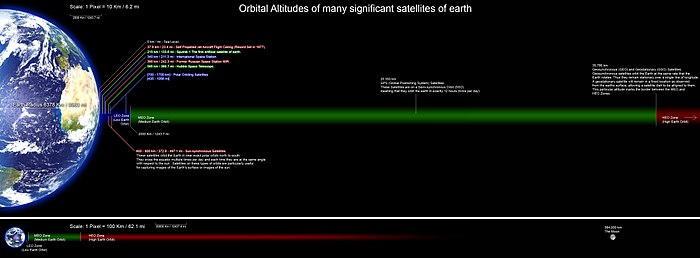
- The International Space Station is in a LEO about 400 km (250 mi) above the Earth's surface.
- Since it requires less energy to place a satellite into a LEO and the LEO satellite needs less powerful amplifiers for successful transmission, LEO is still used for many communication applications. Because these LEO orbits are not geostationary, a network (or "constellation") of satellites is required to provide continuous coverage. (Many communication satellites require geostationary orbits, and move at the same angular velocity as the Earth. Some communications satellites including the Iridium phone system use LEO.)
- Lower orbits also aid remote sensing satellites because of the added detail that can be gained. Remote sensing satellites can also take advantage of sun-synchronous LEO orbits at an altitude of about 800 km (500 mi) and near polar inclination. Envisat is one example of an Earth observation satellite that makes use of this particular type of LEO.
Space debris
The LEO environment is becoming congested with space debris due to the frequency of object launches. This has caused growing concern in recent years, since collisions at orbital velocities can easily be dangerous, and even deadly. Collisions can produce even more space debris in the process, creating a domino effect, something known as Kessler Syndrome. The Joint Space Operations Center, part of United States Strategic Command (formerly the United States Space Command), currently tracks more than 8,500 objects larger than 10 cm in LEO. However, a limited Arecibo Observatory study suggested there could be approximately one million objects larger than 2 millimeters, which are too small to be visible from Earth-based observatories.low earth orbit(LEO)
A low Earth orbit (LEO) is an orbit around Earth with an altitude between 160 kilometers (99 mi) (orbital period
of about 88 minutes), and 2,000 kilometers (1,200 mi) (about 127
minutes). Objects below approximately 160 kilometers (99 mi) will
experience very rapid orbital decay and altitude loss.[1][2]
The orbital velocity needed to maintain a stable low Earth orbit is
about 7.8 km/s, but reduces with increased orbital altitude.
With the exception of the manned lunar flights of the Apollo program, all human spaceflights have taken place in LEO (or were suborbital). The altitude record for a human spaceflight in LEO was Gemini 11 with an apogee of 1,374.1 kilometers (853.8 mi). All manned space stations to date, as well as the majority of satellites, have been in LEO.
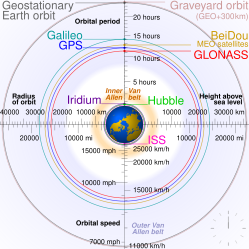
Comparison of GPS, GLONASS, Galileo and Compass (medium earth orbit) satellite navigation system orbits with the International Space Station, Hubble Space Telescope and Iridium constellation orbits, Geostationary Earth Orbit, and the nominal size of the Earth.[a] The Moon's orbit is around 9 times larger (in radius and length) than geostationary orbit.
The orbital velocity needed to maintain a stable low Earth orbit is about 7.8 km/s, but reduces with increased orbital altitude. Calculated for circular orbit of 200 km it is 7.79 km/s and for 1500 km it is 7.12 km/s.[3] The delta-v needed to achieve low Earth orbit starts around 9.4 km/s. Atmospheric and gravity drag associated with launch typically adds 1.5–2.0 km/s to the launch vehicle delta-v required to reach normal LEO orbital velocity of around 7.8 km/s (28,080 km/h).
 Equatorial low Earth orbits (ELEO) are a subset of LEO. These orbits,
with low inclination to the Equator, allow rapid revisit times and have
the lowest delta-v requirement (i.e., fuel spend) of any orbit. Orbits with a high inclination angle to the equator are usually called polar orbits.
Equatorial low Earth orbits (ELEO) are a subset of LEO. These orbits,
with low inclination to the Equator, allow rapid revisit times and have
the lowest delta-v requirement (i.e., fuel spend) of any orbit. Orbits with a high inclination angle to the equator are usually called polar orbits.
Higher orbits include medium Earth orbit (MEO), sometimes called intermediate circular orbit (ICO), and further above, geostationary orbit (GEO). Orbits higher than low orbit can lead to early failure of electronic components due to intense radiation and charge accumulation.
Although the Earth's pull due to gravity in LEO is not much less than on the surface of the Earth, people and objects in orbit experience weightlessness because they are in free fall.
A low Earth orbit is simplest and cheapest for satellite placement. It provides high bandwidth and low communication time lag (latency), but satellites in LEO will not be visible from any given point on the Earth at all times.
With the exception of the manned lunar flights of the Apollo program, all human spaceflights have taken place in LEO (or were suborbital). The altitude record for a human spaceflight in LEO was Gemini 11 with an apogee of 1,374.1 kilometers (853.8 mi). All manned space stations to date, as well as the majority of satellites, have been in LEO.

Orbital characteristics
Objects in LEO encounter atmospheric drag in the form of gases in the thermosphere (approximately 80–500 km up) or exosphere (approximately 500 km and up), depending on orbit height. Objects in LEO orbit Earth between the atmosphere and below the inner Van Allen radiation belt. The altitude is usually not less than 300 km for satellites, as that would be impractical due to atmospheric drag.The orbital velocity needed to maintain a stable low Earth orbit is about 7.8 km/s, but reduces with increased orbital altitude. Calculated for circular orbit of 200 km it is 7.79 km/s and for 1500 km it is 7.12 km/s.[3] The delta-v needed to achieve low Earth orbit starts around 9.4 km/s. Atmospheric and gravity drag associated with launch typically adds 1.5–2.0 km/s to the launch vehicle delta-v required to reach normal LEO orbital velocity of around 7.8 km/s (28,080 km/h).

Higher orbits include medium Earth orbit (MEO), sometimes called intermediate circular orbit (ICO), and further above, geostationary orbit (GEO). Orbits higher than low orbit can lead to early failure of electronic components due to intense radiation and charge accumulation.
Use of LEO
Roughly half an orbit of the ISS.
A low Earth orbit is simplest and cheapest for satellite placement. It provides high bandwidth and low communication time lag (latency), but satellites in LEO will not be visible from any given point on the Earth at all times.
persons to step on moon
Thirty-two astronauts were assigned to fly in the Apollo manned lunar landing program. Twenty-four of these left Earth’s orbit and flew around the Moon (Apollo 1 never launched and Apollo 7 and Apollo 9 were low Earth orbit spacecraft testing missions). In addition, nine astronauts flew Apollo spacecraft in the Apollo Applications Programs Skylab and Apollo–Soyuz Test Project.
Twelve of these astronauts walked on the Moon’s surface, and six of those drove Lunar Roving Vehicles on the Moon. While three astronauts flew to the Moon twice, none of them landed on the Moon more than once. The nine Apollo missions to the Moon occurred between December 1968 and December 1972.
Apart from these 24 people who visited the Moon, no human being has gone beyond low Earth orbit. They have, therefore, been farther from the Earth than anyone else. They are also the only people to have directly viewed the far side of the Moon. The twelve who walked on the Moon are the only people ever to have set foot on an astronomical object other than the Earth.
Of the 24 astronauts who flew to the Moon, two went on to command a Skylab mission, one commanded Apollo–Soyuz, one flew as commander for approach and landing tests of the Space Shuttle, and two went on to command orbital Space Shuttle missions. A total of 24 NASA astronauts from the Apollo era flew on the Space Shuttle.
On each of the Apollo 17 extravehicular activities (EVAs), Harrison Schmitt was the second person out of, and the first person back into, the lunar module. Schmitt is thus the twelfth and last person to have stepped onto the Moon. Eugene Cernan, as the second person to enter the lunar module on the final EVA, is the last person to have walked on the Moon.
Alan Shepard was the oldest person to walk on the Moon, at age 47 years and 79 days. Charlie Duke was the youngest, at age 36 years and 201 days.
Jim Lovell and Fred Haise were scheduled to walk on the Moon during the Apollo 13 mission, but the lunar landing was aborted following a major malfunction en route to the Moon. Haise was again scheduled to walk on the Moon as commander of Apollo 19, but Apollo 18 and Apollo 19 were canceled on September 2, 1970.
Joe Engle had trained on the backup crew for Apollo 14 to explore the Moon with Cernan, but Engle was replaced by Schmitt on the primary crew for Apollo 17. Schmitt had previously been crewed with Apollo 12 command module pilot Dick Gordon in anticipation of Apollo 18, but Schmitt replaced Engle on Apollo 17 after the cancellation of Apollo 18 and Apollo 19, leaving Gordon as the last Apollo astronaut to train extensively for lunar exploration without ever landing on the Moon.
Twelve of these astronauts walked on the Moon’s surface, and six of those drove Lunar Roving Vehicles on the Moon. While three astronauts flew to the Moon twice, none of them landed on the Moon more than once. The nine Apollo missions to the Moon occurred between December 1968 and December 1972.
Apart from these 24 people who visited the Moon, no human being has gone beyond low Earth orbit. They have, therefore, been farther from the Earth than anyone else. They are also the only people to have directly viewed the far side of the Moon. The twelve who walked on the Moon are the only people ever to have set foot on an astronomical object other than the Earth.
Of the 24 astronauts who flew to the Moon, two went on to command a Skylab mission, one commanded Apollo–Soyuz, one flew as commander for approach and landing tests of the Space Shuttle, and two went on to command orbital Space Shuttle missions. A total of 24 NASA astronauts from the Apollo era flew on the Space Shuttle.
Apollo astronauts who walked on the Moon
"Moonwalkers" redirects here. For the upcoming film, see Moonwalkers (film).
Twelve people have walked on the Moon. Eight of them are still living as of November 2015. All manned lunar landings took place between July 1969 and December 1972 as part of the Apollo program.| Name | Born | Died | Age at first step |
Mission | Lunar EVA dates | Service | Alma Mater | |
| 01. | Neil Armstrong | August 5, 1930 | August 25, 2012 (aged 82) | 38y 11m 15d | Apollo 11 | July 21, 1969[6] | NASA[7] | Purdue University, University of Southern California |
| 02. | Buzz Aldrin | January 20, 1930 | 39y 6m 0d | Air Force | United States Military Academy, MIT | |||
| 03. | Pete Conrad | June 2, 1930 | July 8, 1999 (aged 69) | 39y 5m 17d | Apollo 12 | November 19–20, 1969 | Navy | Princeton University |
| 04. | Alan Bean | March 15, 1932 | 37y 8m 4d | Navy | University of Texas, Austin | |||
| 05. | Alan Shepard | November 18, 1923 | July 21, 1998 (aged 74) | 47y 2m 18d | Apollo 14 | February 5–6, 1971 | Navy | United States Naval Academy, Naval War College |
| 06. | Edgar Mitchell | September 17, 1930 | 40y 4m 19d | Navy | Carnegie Mellon University, Naval Postgraduate School, MIT | |||
| 07. | David Scott | June 6, 1932 | 39y 1m 25d | Apollo 15 | July 31 – August 2, 1971 | Air Force | University of Michigan (freshman year, and later, an honorary doctorate), United States Military Academy, MIT | |
| 08. | James Irwin | March 17, 1930 | August 8, 1991 (aged 61) | 41y 4m 14d | Air Force | United States Naval Academy, University of Michigan | ||
| 09. | John W. Young | September 24, 1930 | 41y 6m 28d | Apollo 16 | April 21–23, 1972 | Navy | Georgia Institute of Technology | |
| 10. | Charles Duke | October 3, 1935 | 36y 6m 18d | Air Force | United States Naval Academy, MIT | |||
| 11. | Eugene Cernan | March 14, 1934 | 38y 9m 7d | Apollo 17 | December 11–14, 1972 | Navy | Purdue University, Naval Postgraduate School | |
| 12. | Harrison Schmitt | July 3, 1935 | 37y 5m 8d | NASA | Caltech, University of Oslo (exchange), Harvard University |
Alan Shepard was the oldest person to walk on the Moon, at age 47 years and 79 days. Charlie Duke was the youngest, at age 36 years and 201 days.
Jim Lovell and Fred Haise were scheduled to walk on the Moon during the Apollo 13 mission, but the lunar landing was aborted following a major malfunction en route to the Moon. Haise was again scheduled to walk on the Moon as commander of Apollo 19, but Apollo 18 and Apollo 19 were canceled on September 2, 1970.
Joe Engle had trained on the backup crew for Apollo 14 to explore the Moon with Cernan, but Engle was replaced by Schmitt on the primary crew for Apollo 17. Schmitt had previously been crewed with Apollo 12 command module pilot Dick Gordon in anticipation of Apollo 18, but Schmitt replaced Engle on Apollo 17 after the cancellation of Apollo 18 and Apollo 19, leaving Gordon as the last Apollo astronaut to train extensively for lunar exploration without ever landing on the Moon.
Saturday, October 31, 2015
can stephen halking talk?
Professor Hawking has motor neurone disease and as such is only able to communicate by using a small sensor which is activated by a muscle in his cheek. He uses this sensor to 'type' characters and numbers on his keyboard.
stephen public lectures
Public Lectures

Professor
Hawking has given many lectures to the general public. Below are some of
the more recent public lectures. Included with these lectures is a
Glossary of some of the terms used.
Into a Black Hole 2008
Is it possible to fall in a black hole, and come out in another universe? Can you escape from a black hole once you fall inside? In this lecture I talk about some of the things I've found out about black holes.
The Origin of the Universe 2005
Why are we here? Where did we come from? The answer generally given was that humans were of comparatively recent origin, because it must have been obvious, even at early times, that the human race was improving in knowledge and technology. So it can't have been around that long, or it would have progressed even more.
Godel and the End of Physics 2002In this talk, I want to ask how far can we go in our search for understanding and knowledge. Will we ever find a complete form of the laws of nature? By a complete form, I mean a set of rules that in principle at least enable us to predict the future to an arbitrary accuracy, knowing the state of the universe at one time. A qualitative understanding of the laws has been the aim of philosophers and scientists, from Aristotle onwards.
Space and Time Warps 1999
In science fiction, space and time warps are a commonplace. They are used for rapid journeys around the galaxy, or for travel through time. But today's science fiction, is often tomorrow's science fact. So what are the chances for space and time warps.
Does God Play Dice 1999
This lecture is about whether we can predict the future, or whether it is arbitrary and random. In ancient times, the world must have seemed pretty arbitrary. Disasters such as floods or diseases must have seemed to happen without warning or apparent reason. Primitive people attributed such natural phenomena, to a pantheon of gods and goddesses, who behaved in a capricious and whimsical way. There was no way to predict what they would do, and the only hope was to win favour by gifts or actions.
The Beginning of Time 1996In this lecture, I would like to discuss whether time itself has a beginning, and whether it will have an end. All the evidence seems to indicate, that the universe has not existed forever, but that it had a beginning, about 15 billion years ago. This is probably the most remarkable discovery of modern cosmology. Yet it is now taken for granted. We are not yet certain whether the universe will have an end.
Life in the Universe 1996
In this talk, I would like to speculate a little, on the development of life in the universe, and in particular, the development of intelligent life. I shall take this to include the human race, even though much of its behaviour through out history, has been pretty stupid, and not calculated to aid the survival of the species.
Into a Black Hole 2008
Is it possible to fall in a black hole, and come out in another universe? Can you escape from a black hole once you fall inside? In this lecture I talk about some of the things I've found out about black holes.
The Origin of the Universe 2005
Why are we here? Where did we come from? The answer generally given was that humans were of comparatively recent origin, because it must have been obvious, even at early times, that the human race was improving in knowledge and technology. So it can't have been around that long, or it would have progressed even more.
Godel and the End of Physics 2002In this talk, I want to ask how far can we go in our search for understanding and knowledge. Will we ever find a complete form of the laws of nature? By a complete form, I mean a set of rules that in principle at least enable us to predict the future to an arbitrary accuracy, knowing the state of the universe at one time. A qualitative understanding of the laws has been the aim of philosophers and scientists, from Aristotle onwards.
Space and Time Warps 1999
In science fiction, space and time warps are a commonplace. They are used for rapid journeys around the galaxy, or for travel through time. But today's science fiction, is often tomorrow's science fact. So what are the chances for space and time warps.
Does God Play Dice 1999
This lecture is about whether we can predict the future, or whether it is arbitrary and random. In ancient times, the world must have seemed pretty arbitrary. Disasters such as floods or diseases must have seemed to happen without warning or apparent reason. Primitive people attributed such natural phenomena, to a pantheon of gods and goddesses, who behaved in a capricious and whimsical way. There was no way to predict what they would do, and the only hope was to win favour by gifts or actions.
The Beginning of Time 1996In this lecture, I would like to discuss whether time itself has a beginning, and whether it will have an end. All the evidence seems to indicate, that the universe has not existed forever, but that it had a beginning, about 15 billion years ago. This is probably the most remarkable discovery of modern cosmology. Yet it is now taken for granted. We are not yet certain whether the universe will have an end.
Life in the Universe 1996
In this talk, I would like to speculate a little, on the development of life in the universe, and in particular, the development of intelligent life. I shall take this to include the human race, even though much of its behaviour through out history, has been pretty stupid, and not calculated to aid the survival of the species.
Subscribe to:
Posts (Atom)