A low Earth orbit (LEO) is an orbit around Earth with an altitude between 160 kilometers (99 mi) (orbital period
of about 88 minutes), and 2,000 kilometers (1,200 mi) (about 127
minutes). Objects below approximately 160 kilometers (99 mi) will
experience very rapid orbital decay and altitude loss.[1][2]
The orbital velocity needed to maintain a stable low Earth orbit is
about 7.8 km/s, but reduces with increased orbital altitude.
With the exception of the manned lunar flights of the Apollo program, all human spaceflights have taken place in LEO (or were suborbital). The altitude record for a human spaceflight in LEO was Gemini 11 with an apogee of 1,374.1 kilometers (853.8 mi). All manned space stations to date, as well as the majority of satellites, have been in LEO.
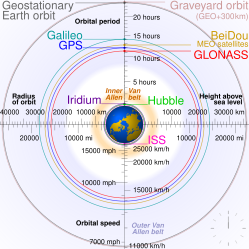
Comparison of GPS, GLONASS, Galileo and Compass (medium earth orbit) satellite navigation system orbits with the International Space Station, Hubble Space Telescope and Iridium constellation orbits, Geostationary Earth Orbit, and the nominal size of the Earth.[a] The Moon's orbit is around 9 times larger (in radius and length) than geostationary orbit.
The orbital velocity needed to maintain a stable low Earth orbit is about 7.8 km/s, but reduces with increased orbital altitude. Calculated for circular orbit of 200 km it is 7.79 km/s and for 1500 km it is 7.12 km/s.[3] The delta-v needed to achieve low Earth orbit starts around 9.4 km/s. Atmospheric and gravity drag associated with launch typically adds 1.5–2.0 km/s to the launch vehicle delta-v required to reach normal LEO orbital velocity of around 7.8 km/s (28,080 km/h).
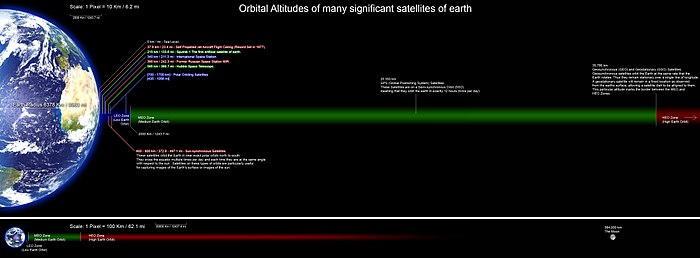 Equatorial low Earth orbits (ELEO) are a subset of LEO. These orbits,
with low inclination to the Equator, allow rapid revisit times and have
the lowest delta-v requirement (i.e., fuel spend) of any orbit. Orbits with a high inclination angle to the equator are usually called polar orbits.
Equatorial low Earth orbits (ELEO) are a subset of LEO. These orbits,
with low inclination to the Equator, allow rapid revisit times and have
the lowest delta-v requirement (i.e., fuel spend) of any orbit. Orbits with a high inclination angle to the equator are usually called polar orbits.
Higher orbits include medium Earth orbit (MEO), sometimes called intermediate circular orbit (ICO), and further above, geostationary orbit (GEO). Orbits higher than low orbit can lead to early failure of electronic components due to intense radiation and charge accumulation.
Although the Earth's pull due to gravity in LEO is not much less than on the surface of the Earth, people and objects in orbit experience weightlessness because they are in free fall.
A low Earth orbit is simplest and cheapest for satellite placement. It provides high bandwidth and low communication time lag (latency), but satellites in LEO will not be visible from any given point on the Earth at all times.
With the exception of the manned lunar flights of the Apollo program, all human spaceflights have taken place in LEO (or were suborbital). The altitude record for a human spaceflight in LEO was Gemini 11 with an apogee of 1,374.1 kilometers (853.8 mi). All manned space stations to date, as well as the majority of satellites, have been in LEO.

Orbital characteristics
Objects in LEO encounter atmospheric drag in the form of gases in the thermosphere (approximately 80–500 km up) or exosphere (approximately 500 km and up), depending on orbit height. Objects in LEO orbit Earth between the atmosphere and below the inner Van Allen radiation belt. The altitude is usually not less than 300 km for satellites, as that would be impractical due to atmospheric drag.The orbital velocity needed to maintain a stable low Earth orbit is about 7.8 km/s, but reduces with increased orbital altitude. Calculated for circular orbit of 200 km it is 7.79 km/s and for 1500 km it is 7.12 km/s.[3] The delta-v needed to achieve low Earth orbit starts around 9.4 km/s. Atmospheric and gravity drag associated with launch typically adds 1.5–2.0 km/s to the launch vehicle delta-v required to reach normal LEO orbital velocity of around 7.8 km/s (28,080 km/h).

Higher orbits include medium Earth orbit (MEO), sometimes called intermediate circular orbit (ICO), and further above, geostationary orbit (GEO). Orbits higher than low orbit can lead to early failure of electronic components due to intense radiation and charge accumulation.
Use of LEO
Roughly half an orbit of the ISS.
A low Earth orbit is simplest and cheapest for satellite placement. It provides high bandwidth and low communication time lag (latency), but satellites in LEO will not be visible from any given point on the Earth at all times.

No comments:
Post a Comment